
Principles
For us, awareness means being mindful and conscious of how we treat one another. It means preventing discrimination, boundary violations and violence, including sexualised violence. This includes recognising power relations in society and our own position within them.
Discrimination and violence are not isolated incidents, but take place within a structural and societal context. Awareness is an approach that emerged in 2007 from the feminist and queer movements. The debates and practices of the second-wave women’s movement of the 1970s were an important starting point. In addition, the approaches and practices of the Transformative Justice movement and Community Accountability in the United States have influenced awareness work in German-speaking countries.
At the heart of awareness is the wellbeing of the person affected by boundary-crossing behaviour, discrimination or violations. This involves support that takes the affected person’s side – if they wish to receive it – so that they are not left to deal with the consequences of discrimination or violence, including sexualised violence, on their own. The approach is intersectional and takes into account overlapping experiences of discrimination and violence.
Support also includes creating safer spaces so that affected people do not have to withdraw from spaces or structures, but can gain or regain agency, while further risks and unwanted encounters can be prevented.
Awareness work also has a preventive role. In some communities, it is offered alongside transformative work with people who discriminate or perpetrate violence, reflecting on the wider social environment in the spirit of Community Accountability. Awareness work can encompass a range of approaches and possibilities. It requires critically reflected experiential knowledge, a solid grounding in practice and appropriately trained teams. In all cases, awareness work is guided by principles such as consent and the needs of the person seeking support, putting solidarity with that person into practice.

Violence takes many different forms. In our work, we oppose violence and work with those affected to develop options for action and strategies for responding to it. To do this, it is important to understand the different levels at which violence operates. These manifest differently in individual and interpersonal contexts, in institutional and state forms, and in structural and discriminatory forms. You can read more in the brochure “Providing Support: Strategies for Responding to Violence and Discrimination” (see the links below)!
The aim of our work is to make ourselves no longer needed. We work towards a society in which everyone treats one another with care and solidarity. A society in which people have the tools and the scope to make decisions and navigate conflicts mindfully and without violence.
We believe that empowerment and emancipatory work can provide a path towards this society.
Links & Further Reading
Awareness Institut
We are part of the Awareness Institut – the association for awareness work in German-speaking countries.
The Awareness Institut brings together awareness practitioners from German-speaking countries who develop and offer awareness concepts and training. We make awareness visible and accessible to event organisers, people affected by discrimination and violence, and anyone interested.
transformativejustice.eu
transformativejustice.eu >>> who we are – Our group has been working on sexualised violence, Community Accountability and Transformative Justice since 2011. We seek to further develop and share concepts and practices for communities that are needed to advance how we address sexualised violence and violence in close relationships. Our aim is to analyse these forms of violence in relation to different power structures and find ways to navigate their complex intersections.
Anti-Sexist Awareness Handbook:
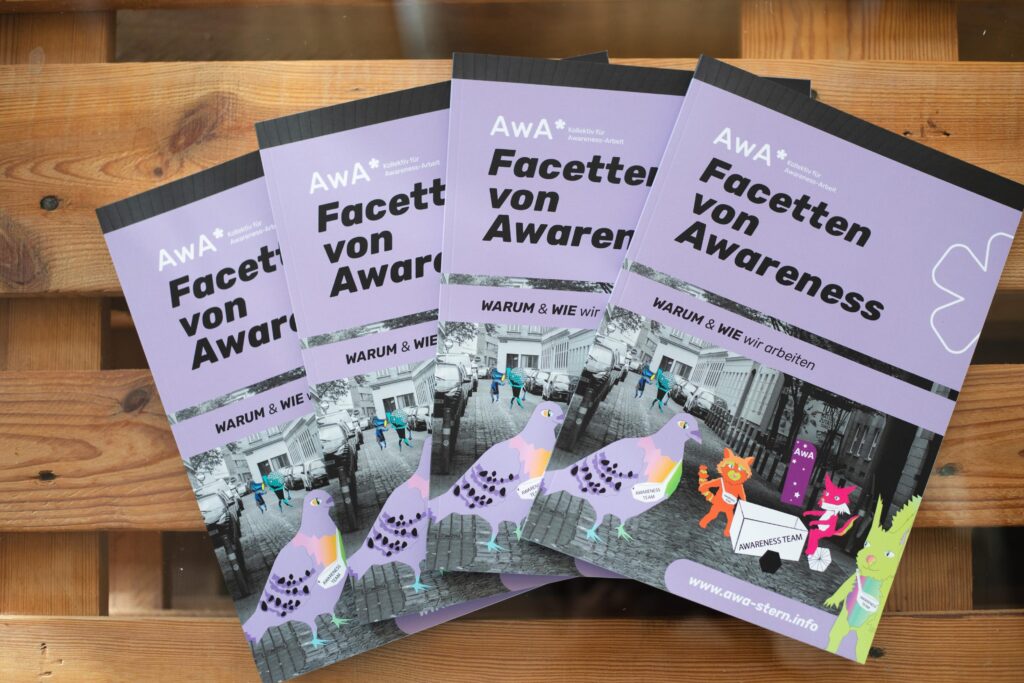
Together with SupportFX (Leipzig), and as part of the Awareness Institut network, we have defined procedures and standards for awareness work. These are compiled in the following brochure:
Respect Guide (German, English, French)
The Respect Guide offers guidance on treating one another with respect.
http://www.i-paed-berlin.de/de/Downloads/
The brochure “Intersex and Language” explains terminology relating to intersex to encourage respectful use of language. https://oiigermany.org/inter-und-sprache/
Resources from Les MIGRAS
https://lesmigras.de/de/informationen-downloads
The brochure “Setting Boundaries – A Workbook” explores setting personal boundaries in a wide range of contexts. Texts and exercises invite you to engage with the topic. Berlin, 2017.
https://lesmigras.de/wp-content/uploads/2021/06/LesMigraS_Grenzen_Setzen_online.pdf
Brochure: Speaking Connections. Empowerment in Relation to Racism and Transphobia in LGBTI Contexts.
https://lesmigras.de/wp-content/uploads/2021/06/LM_Broschuere_Tapesh_einzelseiten_korrigiert.pdf
Brochure: Providing Support. Strategies for Responding to Violence and Discrimination.
https://lesmigras.de/wp-content/uploads/2021/06/LM_Broschuere_Tapesh_UnterstuetzungGeben.pdf
What Is Multiple Discrimination?
A text by Les MIGRAS on multiple discrimination, multiple affiliations and anti-discrimination work.
A more in-depth text is available here as a PDF: https://lesmigras.de/wp-content/uploads/2021/01/LesMigraS_Mehrfachdiskriminierung_vertiefend.pdf
In Easy Language: We explain belonging to multiple groups and experiencing multiple forms of disadvantage: https://lesmigras.de/wp-content/uploads/2021/01/LesMigraS_Was_ist_Mehrfachdiskrimierung_Leichte_Sprache.pdf
Transnational Transformative Justice Project
Zine: Mapping our madness: a workbook for navigating crisis, extreme states, or just foul moods
Looking for an Awareness team or support structure for your event?
Find out more here: